|
| Bauhinia blakeana Back to Top |
|
 | Hong Kong Orchid Tree |
A striking specimen with a spreading branch structure that forms an umbrella-like crown 20 feet tall by 25 feet wide with large, bright green, butterfly-shaped leaves. Blooms winter through spring with abundant masses of gorgeous, 6 inch, orchid-like flowers, which open a deep wine red and fade to lavender with a hint of white.
|
Cedrus atlantica
|
|
| | Aurea | Considered one of the most beautiful of all conifers. A large, pyramidal tree with attractive, needle-like foliage. Noted for its bright, golden yellow color. Provides a striking colo | |
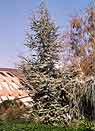 | Glauca |
Similar in growth habit and form to 'Aurea'. Grafted plants of the 'Glauca' strain insure its bright, powder blue color. Grows in a natural bonsai style; it also makes a beautiful container specimen if started early. |
 | Glauca Pendula |
Exquisite, weeping accent plant. This beautiful form of cedar can be trained to any shape or form. Branches droop vertically, and with age make a superb garden specimen. Will grow horizontally across the ground unless trained or staked. Striking powder flue foliage makes it a real eye-catcher. |
|
| Chorisia insignis |
|
 | White Cloud |
Noted for its bottle-shaped trunk and unique, erratic growth habit. Adding to the uniqueness of this tree, are its heavy, sharp spines, densely studding the trunk and lower branch structure. Tree blooms with an abundance of showy, cream-colored flowers and dangling fruits which often split open to release a white, silky floss material. |
|
| | Chorisia speciosa |
| | Pink Thornless Selection |
Similar in growth pattern to Chosisia insignis, this particular selection shows a slightly more uniform growth character with a completely thornless trunk. Young trees show bright green bark color, fading to gray-green with age. This selection is also noted for its superior, bright pink flower color, making it s striking, standout specimen during its autumn blooming season. |
|
| Eriobotrya |
|
| | Deflexa (Bronze Loquat) |
An outstanding, compact, evergreen tree growing to 15 feet in height. New foliage displays a bright, reddish-bronze color, while mature leaves are a dark forest green. Our grafted selection was chosen for its ability to hold its reddish-bronze color longer than most. Produces attractive, creamy-white flowers in spring. Grown in multi (bush) and standard (patio tree) forms. |
|
| | x Coppertone |
A very popular ornamental. Developed by Bordier's Nursery in Irvine, California. This small tree or large shrub is a cross of Eriobotrya and Photinia, showing the best characters of both: dark green, glossy foliage with a bronze color to the new growth, as well as bright pink, showy flowers in the spring. Very easy to manage, tight, dense growth habit. Our grafted strain shows more vigor at a young age than other, cutting-grown plants, and is much easier to train as an upright or standard tree form. Grown in multi (bush) and standard (patio tree) forms. |
|
| Fraxinus |
|
| | oxycarpa 'Raywood' (Claret Ash) |
An introduction by the Saratoga Horticultural Foundation. A fast-growing, round-headed form which grows to 35 or more feet. Deciduous, dark green foliage turns wine red in the fall. Resistant to Ash Blight, rot tolerant. |
|
| | uhdei 'Orange County' |
A great tree for quick shade. A vigorous grower, strongly branched to a round-headed form of 35 or more feet. More evergreen than other uhdei selections. Large, compound, dark green, glossy leaves. |
|
| Ginkgo biloba |
|
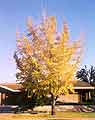 | Autumn Gold |
Regarded as one of the most attractive deciduous trees for street-side, park, and garden planting. Unique, fan-shaped, deep green leaves retain their color throughout the season, turning a brilliant golden yellow in late autumn. Long-lived tree is very easy to maintain. This grafted male strain does not set fruit. |
|
| | Saratoga |
Very abundant, drooping leaves are triangular and elongated with deeply cut lower end. Fall color is an exceptional bright yellow with the leaves falling quickly to make a colorful pattern on the ground. Slow-growing, densely branched tree acquires a pyramidal shape when mature. This grafted male strain does not set fruit. |
|
| Juniper scopulorum |
|
| | Tolleson's Weeping Blue |
A spectacular tree-like form growing to 20 feet tall with graceful, arching branches and weeping main lead. Cascading, silvery, powder blue foliage is reminiscent of a fountain or waterfall. Often used as a container plant, it is a spectacular specimen in any landscape. |
|
|
| | Tolleson's Weeping Green |
Exhibits the same growth habit as 'Weeping Blue', with the exception of the foliage, which is an attractive sea green. |
|
| |
|
| | Burgundy |
A delicious 'Dancy Tangerine' and sweet grapefruit hybrid. Attractive fruit is bright orange-red with a prominent 'neck'. Rich, flavorful flesh is very sweet and juicy. Handsome plant thrives in all citrus climates. Self-fertile. |
|
| | Festival |
Introduced by the Saratoga Horticultural Foundation in 1962. This beautiful specimen maintains its columnar habit when young - older trees become more pyramidal. The deep green summer leaves turn a burgundy-red in late November and December and remain on the tree fully colored into January; longer than other Liquidambar varieties. |
|
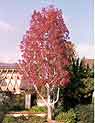 | Palo Alto |
Grown as a street tree in the city of Palo Alto. It has a well-proportioned, pyramidal habit and brilliant orange-red autumn leaves, which usually appear around Thanksgiving and are uniform throughout the tree. Grafted plants usually grow 4-6 feet in the first year, and 2-3 feet every year thereafter. |
|
| | Pendula |
An introduction in 1980 by La Verne Nursery, Inc. This weeping variety of Liquidambar styraciflua shows upright character when young, developing a pendulous, weeping habit of side branching when mature. It is also distinctively noted for its rough, corky bark character, giving it exceptional ornamental appeal, even when dormant. Fall color is bright crimson red. |
|
| | Rotundiloba |
A fast grower; its somewhat narrow form when young becomes more rounded with age. Unique, round green leaves have less serration to leaf margins than other Liquidambar varieties. The leaves turn a spectacular purple in the fall. The main attribute of this cultivar is that no fruit develops after flowering. |
|
| |
|
| | Magnolia grandiflora |
The 'Southern Magnolia' is well known as one of the more exotic of the broad-leafed, evergreen, flowering trees, which have been widely used in the landscapes of California for many years. Magnolias add shade, beauty, and fragrance to any garden. |
|
| | Big Leaf |
'Immense, glossy, dark green, leathery leaves adorn the open-branched, pyramidal shape, 35-40 feet high by 15-20 feet wide. Huge, cup-shaped, fragrant, white flowers crown this magnificent tree in summer. |
|
| | Little Gem |
A winner! An exceptional dwarfed variety; very compact, upright, branching, narrow form reaches 15-20 feet high by 10-15 feet wide. The foliage is smaller, dark emerald green, with a velvety, rusty-bronze coloring on the leaf underside, providing a remarkable contrast. A heavy bloomer; pure white flowers of 6 inches across appear early and bloom throughout the summer. A great variety for espalier or for use in a compact landscape. In this nursery's opinion, the 'Little Gem' is the most useful and versatile Mangolia grandiflora cultivar to be introduced in years. |
|
| | Russet |
Introduced by the Saratoga Horticultural Foundation in 1965. An outstanding pyramidal form which maintains a strong, upright branching habit and is fast growing to upwards of 40 feet. Dark, glossy, narrow green leaves have a leathery felting on the underside. Flowers are fairly flat, about 10 inches across, soft and velvety to the touch, and are intensely fragrant with an unusual lemon-like scent. Flowers are produced intermittently through the summer and last for several days - longer than other varieties. |
|
| | St. Mary |
An introduction of the W.B. Clarke & Co. Nursery of San Jose, California. Somewhat slower growing than other varieties, but does achieve full height. This tree is characterized by its small, glossy green leaves, which are generally no longer than six inches long. The flowers are porcelain white in color, cup-shaped, and about six inches across; they are produced freely throughout the summer. This variety is noted for its abundant flowering at a very early age. |
|
| | Samuel Sommer |
Selected by Maunsell van Rensellaer in 1952, it was the first Magnolia grandiflora selection to be evaluated and introduced by the Saratoga Horticultural Foundation. The tree exhibits a strong and vigorous habit of growth, which is characterized by an ascending branch system and the development of a symmetrical and compact crown. This variety has imposing, glossy, dark green leaves, which have a conspicuous, yellow-green midrib. The flowers are massive, and on well-grown trees, most will develop to a diameter of 12 to 14 inches when fully open. They are creamy white and have an exceptionally sweet fragrance; prized for cutting and decorating use. |
|
| |
|
| | Doltsopa |
A slow growing, upright, cone-shaped form when young; broadens with age to 25 feet high by 25 feet wide. Thin, shiny, leathery, deep green leaves frame huge, fragrant, creamy white, magnolia-like flowers which appear along the branches in late winter. |
|
| |
|
|
| | calleryana 'Aristocrat' |
Discovered in 1969 by Carlisle Nursery in Kentucky, as a seedling mutation. A central leader tree with strong, upswung branching and an early pyramidal form; matures into a round-headed tree of 30 feet. Tree displays a striking purple-red fall color which, in California, holds onto the tree well into the winter with superb white blooms in the spring. More resistant to fire blight than most Pyrus cultivars. |
|
|
| | calleryana 'Bradford' |
A vigorous growing, densely headed, medium-sized shade tree, which maintains a typical Pyrus form when young. Its rich green, wavy foliage turns to an attractive scarlet in the fall; the tree displays dense clusters of white flowers in the early spring. |
|
|
| | kawakami |
An old-time favorite in California, Arizona, and Texas. An attractive evergreen which grows to 30 feet tall with a 20 foot spread; also works well as an espalier. Bright, shiny, green foliage turns to a reddish-orange in the fall and drops for a very short period before blooming with bright white, fragrant flowers. |
|
|
| |
|
|
.jpg) | Variegated |
An attractive addition to any landscape. Handsome, upright tree grows to 30-60 feet, getting more rounded in form as it matures. Bright green, leathery leaves have creamy-yellow variegation. Reddish-brown bark peels away to show smooth, new bark underneath. |
|
|
| |
|
| | Wisteria floribunda |
The wisteria is a vine of incomparable beauty. Named in 1818 in honor of Caspar Wistar, of the University of Pennsylvania, the wisteria is native to North America, as well as to China and Japan. Deciduous vines with twining stems grow vigorously to 25 feet; best if trained on an arbor, trellis, or fence to allow the best view of sensational, pendulous, 15-18 inch clusters of spring blooms. Compound foliage is bright green with a soft yellow fall color. |
|
| | Alba |
Pure white flower clusters have a mild, pleasant fragrance. |
|
| | Rosea |
Soft pink flower clusters. |
|
| | Royal Purple |
Deep lavender flower clust. |
| |